
Carriage Style vs Traditional Garage Door: Which One Is Right for Your Home?
Carriage style vs traditional garage door comes down to this: carriage style doors offer a classic, decorative look inspired by historic horse-drawn carriage houses, while traditional sectional overhead doors prioritize straightforward functionality, easier automation, and lower upfront cost. Here’s a quick breakdown:
| Feature | Carriage Style | Traditional Overhead |
|---|---|---|
| Appearance | Rustic, decorative, historic charm | Clean, modern, simple panels |
| Operation | Overhead (or true swing-out) | Sectional overhead lift |
| Best for | Craftsman, farmhouse, Colonial homes | Modern, suburban, minimalist homes |
| Maintenance | Moderate to high (especially wood) | Low to moderate |
| Curb appeal | High — standout visual impact | Neutral — blends into facade |
| Customization | Extensive | Moderate |
| Lifespan | 20–30 years with proper care | 15–25 years |
Choosing the wrong style can mean a door that clashes with your home’s architecture, wastes overhead space, or costs more to maintain than you planned for. This guide cuts through the noise so you can make a confident decision — no guesswork required.
I’m Tony Aguilar, founder of First Choice Garage Doors with over 30 years of hands-on experience helping homeowners navigate decisions exactly like the carriage style vs traditional garage door debate. That experience shapes every recommendation in this guide, so you’re getting real-world insight — not just theory.
Defining the Styles: History and Modern Functionality
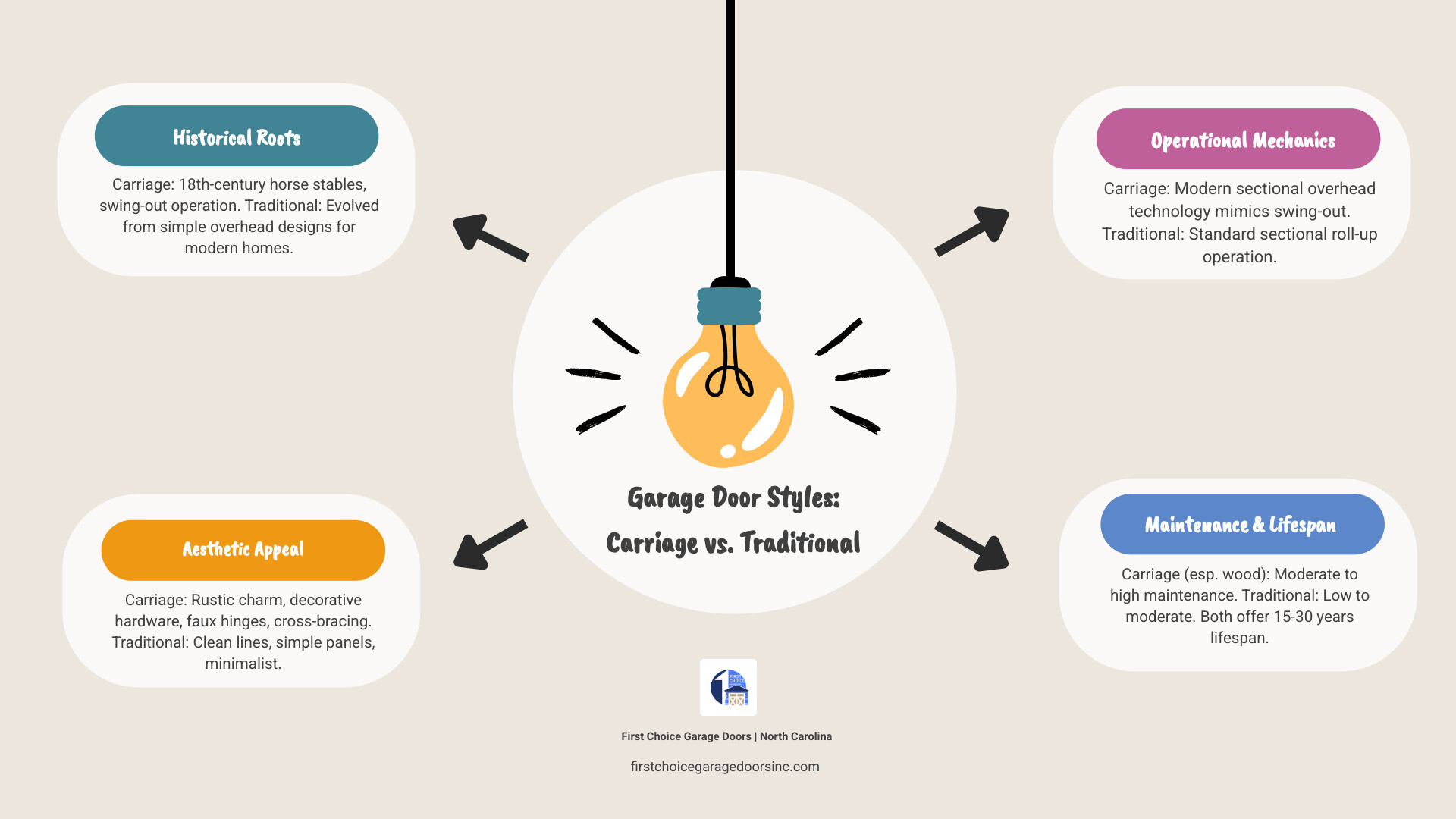
To understand the What Are Carriage Garage Doors question, we have to look back to the 18th and 19th centuries. Before the automobile took over, carriage houses were separate buildings used to store horse-drawn carriages and the horses themselves. These buildings featured large, heavy wooden doors that swung outward on massive iron hinges to allow wide passage.
As cars replaced carriages, the “carriage house” aesthetic remained popular, but the manual swing-out operation became a hassle. In 2026, when we talk about carriage doors, we are usually referring to “carriage house style” doors. These are modern sectional doors that look like they swing out but actually roll up into the ceiling on tracks. This blend of vintage charm and modern sectional overhead technology gives homeowners the best of both worlds.

On the other side of the carriage style vs traditional garage door coin is the standard traditional door. These became the North American standard during the mid-20th century. They are defined by their horizontal panels—often with “raised” or “recessed” rectangles—and their focus on utility. They don’t try to look like barn doors; they look like clean, reliable garage doors that disappear when you press a button.
Carriage Style vs Traditional Garage Door: Aesthetic and Architectural Differences
When comparing carriage style vs traditional garage door aesthetics, the differences are striking. Carriage doors are designed to be a focal point of the home. They often feature vertical wood grain, cross-bracing (like X, V, or A patterns), and heavy decorative hardware such as faux hinges and handles.
Traditional doors are more subtle. They usually feature horizontal paneling and lack the “busy” decorative elements of their carriage cousins.
| Feature | Carriage Style | Traditional Style |
|---|---|---|
| Visual Focus | Bold, rustic, “Barn-like” | Clean, symmetrical, “Suburban” |
| Hardware | Large straps, handles, and latches | Usually minimal or recessed |
| Paneling | Vertical boards or overlays | Horizontal raised/flat panels |
| Window Shapes | Often arched or with detailed grilles | Rectangular or square lites |
The Carriage House Garage Doors we install often serve as the “jewelry” of the home. But which one fits your house?
- Craftsman and Farmhouse: These are the bread and butter for carriage doors. The rustic overlays and cross-buck designs perfectly complement low-pitched roofs and earth tones.
- Victorian and Colonial: These styles benefit from the Carriage Style Garage Doors For Different Architectural Styles that lean into elegance, often featuring arched windows and high-end wood finishes.
- Modern and Minimalist: Here, the traditional door often wins. A sleek, flat-panel traditional door in black or bronze provides a clean line that doesn’t distract from the home’s contemporary architecture.
Operational Mechanics and Space Requirements
One of the most important technical aspects of the carriage style vs traditional garage door debate is how the door actually moves.
Most modern doors of both styles are sectional overhead doors. This means they are made of several horizontal panels that bend as they move up a track. This design is incredibly space-efficient. However, there are some differences in clearance requirements:
- Headroom: Traditional roll-up doors typically require 12–15 inches of headroom above the door opening to accommodate the tracks and the torsion spring. If your Fayetteville garage has a very low ceiling, we may need to use low-headroom hardware.
- Driveway Clearance: If you opt for a “true” carriage door (one that actually swings outward), you must have enough driveway space to allow the doors to clear. You can’t park your car right up against the door and open it. For most of our customers in North Carolina, the overhead version is preferred because it allows you to park inches away from the door without issue.
- Bifold Alternatives: In some high-end custom projects, we see bifold doors. These fold horizontally like a closet door. They offer a unique look but require specialized maintenance.
Whether you choose carriage or traditional, both are fully compatible with modern automation. At First Choice Garage Doors, we ensure that every Residential Garage Door Installation in Fayetteville is paired with a smart opener that allows you to monitor your door from your phone, regardless of its style.
Durability, Maintenance, and Energy Efficiency
There are several Reasons To Get Carriage Garage Doors, but you must consider the material.
- Wood: The most authentic look but the highest maintenance. In the humid North Carolina climate, natural wood doors require regular staining or painting to prevent rot and warping.
- Steel and Composite: This is where modern engineering shines. Many carriage doors are now made of steel with composite overlays. You get the look of wood with the durability of metal.
- Traditional Steel: Traditional doors are almost always made of galvanized steel. They are incredibly resistant to dents, scratches, and the elements, requiring only occasional cleaning and lubrication.
Energy Efficiency Don’t let the “old-fashioned” look of carriage doors fool you. Modern Tag/Carriage House Garage Doors can be incredibly energy efficient.
We look at the R-value, which measures thermal resistance. Traditional and carriage doors can both be fitted with high-quality polyurethane insulation. This is vital for attached garages in Fayetteville, as it helps keep the rooms above or adjacent to the garage at a comfortable temperature year-round. A well-insulated door acts as a barrier against the summer heat and winter chills, potentially lowering your energy bills.
Frequently Asked Questions
How do carriage style vs traditional garage door security features compare?
From a security standpoint, both styles are very similar when using modern overhead tracks. They both utilize advanced openers with rolling codes, which change the access code every time the remote is used to prevent hacking. Steel-reinforced panels in both styles offer excellent resistance to forced entry. The primary difference is in the windows; carriage doors often have more glass, which can be a vulnerability if not using tempered or frosted glass. Our Residential Garage Door Repair team can also retro-fit older doors with modern locking mechanisms to boost security.
Which carriage style vs traditional garage door is better for small driveways?
The traditional sectional overhead door (and the modern overhead carriage door) is the clear winner for small driveways. Because they lift vertically, they don’t require any “swing zone” in front of the garage. If you have a short driveway or frequently park a second car right in front of the garage, you should avoid true swing-out carriage doors. For a Garage Door Replacement in Fayetteville, we almost always recommend the overhead sectional version of the carriage style to save space.
What are the customization options for these door types?
The sky is the limit! For carriage doors, you can choose window lites (the small panes of glass), specialty glass (frosted, seeded, or obscure), and various woodgrain textures. For traditional doors, customization usually focuses on the panel profile (long vs. short panels) and the color. Both styles can be color-matched to your home’s trim. Regular Residential Garage Door Maintenance ensures that these custom finishes—like decorative hardware or specialty paint—stay looking new for years.
Conclusion
The carriage style vs traditional garage door choice is one of the most impactful decisions you can make for your home’s exterior. Whether you want the historic, high-impact charm of a carriage house design or the sleek, low-maintenance reliability of a traditional door, the key is quality installation.
Fayetteville architecture is diverse, ranging from classic Colonial homes to modern new builds. At First Choice Garage Doors, we pride ourselves on matching the perfect door to your specific home style. We prioritize safety standards and quality craftsmanship, ensuring that your new door isn’t just beautiful, but also a secure, long-lasting investment.
If you’re ready to transform your home’s curb appeal, explore our full range of Residential Garage Doors and let our expert team help you make the right choice for your lifestyle and budget. Reach out to us today for a consultation—we look forward to serving you!